

11 February 2026
Spain progresses towards recognition of dental specialties
Categories:Institutional, National Activities
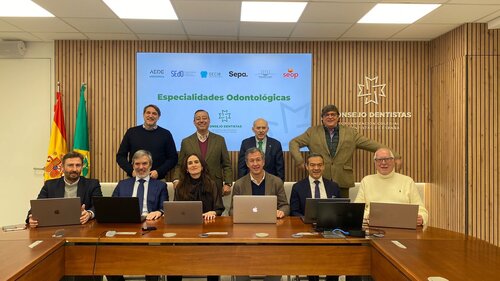
A major step has been taken in advancing the formal recognition of dental specialties in Spain, following the submission of comprehensive applications to the Spanish Ministry of Health by six local scientific societies. This national regulatory milestone resonates with wider European efforts, including a longstanding priority of the European Federation of Periodontology to secure recognition of periodontology as a dental specialty across the European Union (EU).
At a meeting of the national Commission on Dental Specialties, scientific leaders completed and lodged the formal application dossiers for establishing new health-care specialties and structured postgraduate training pathways. The six proposed dental specialities are periodontology, oral surgery, paediatric dentistry, orthodontics and dentofacial orthopaedics, prosthodontics, and endodontics.
These submissions reflect years of preparatory work by both scientific societies and academic institutions, supported by regional health authorities. The Ministry of Health now has up to six months to issue an initial decision. A favourable outcome would move the process into a regulatory phase (including the drafting of specific decrees and public consultation on training programmes) before the specialties become fully operational.
Professor José Nart, past president of the Spanish Society of Periodontology and Osseointegration (Sepa) said: “The submission of these applications represents a decisive step for periodontology and for dentistry as a whole. Formal recognition as a specialty is not an end in itself, but a way to ensure high-quality, structured training, patient safety and professional clarity. Developments such as this reflect a broader European reality, where periodontology is increasingly recognized as a distinct and essential field within modern dental care.”
Although this process is taking place within the Spanish regulatory context, it aligns with broader priorities across Europe to harmonise specialist education and improve professional recognition. The EFP has repeatedly highlighted the need for EU-wide speciality recognition of periodontology as a means to support the free movement of specialists, uphold high standards of training, and enhance patient safety. While periodontology is formally recognized as a specialty in several European countries, it does not yet enjoy uniform legal status across the EU, one of the motivations behind the federation’s advocacy.
Recognition at European level would also strengthen the clarity and comparability of specialist qualifications throughout the continent, complementing existing postgraduate programmes such as the EFP-accredited three-year postgraduate education in periodontology and implant dentistry. These programmes aim to harmonise specialist training and provide recognized pathways to expertise.
The documentation submitted in Spain was prepared by scientific societies representing each proposed specialty. Importantly, the submission follows broad institutional backing at regional level, a key condition under the regulatory framework, and reflects growing consensus on the value of formal specialty recognition.
For the EFP, this development represents not just a national progression but a step forward in a broader European journey towards harmonized, recognized dental specialist education. “Recognition of periodontology as a dental specialty has been a strategic priority for the EFP for many years,” explains Professor Spyros Vassilopoulos, EFP president. “National initiatives that move in this direction are important signals of progress and alignment with European needs. Harmonized specialty recognition across Europe is essential to support excellence in education, professional mobility and, ultimately, better outcomes for patients.”
Sign up for our newsletter
The EFP publishes a free monthtly email newsletter with the latest news about the federation's activities, its publications, and its campaigns.
EFP partners









Sign up to our newsletter
The EFP publishes a free monthtly email newsletter with the latest news about the federation's activities, its publications, and its campaigns.
