
Classification & Guidelines, Article
Acute periodontal conditions: from emergency management to definitive care
10 November 2026
Acute periodontal conditions demand rapid decisions, but speed should not come at the expense of diagnosis. The new EFP clinical-practice guideline of the management of these conditions offers a simple clinical logic: identify the lesion, control the acute problem, then treat the disease or factors that allowed it to develop. Selena Toma, EFP guideline panel member and co-author of the systematic review on periodontal abscesses and endodontic-periodontal lesions, explains what the new EFP guidelines means for everyday practice.
Key clinical messages
• Diagnosis comes first: similar symptoms may arise from very different periodontal or endodontic problems.
• Drainage is first-line treatment for periodontal abscess; definitive deep instrumentation comes later.
• Reassess acute conditions after 48-72 hours to confirm improvement and plan the next stage.
• Systemic antibiotics are not routine treatment when effective local care can be delivered.
• The emergency visit is only the first step: the underlying periodontal, endodontic, and predisposing factors still need to be managed.
Acute periodontal conditions are less common than chronic gingivitis and periodontitis, but their clinical impact can be considerable. They may present with pain, infection, and rapid tissue destruction, and some cases can be accompanied by systemic involvement. According to the 2018 World Classification of periodontal diseases and conditions, the three main acute periodontal conditions are necrotizing periodontal diseases, periodontal abscesses, and acute manifestations of endodontic-periodontal lesions (EPLs).
The new EFP S2k-level clinical practice guideline (CPG) was developed to turn the available evidence into practical decisions at the chairside. Two commissioned systematic reviews informed the process, followed by structured discussion and voting at the 21st European Workshop on Periodontology, held at La Granja de San Ildefonso (Spain) in November 2025. Because direct evidence is limited for several acute conditions, the guideline is also transparent about where recommendations rely on expert consensus.
One pathway, three different emergencies
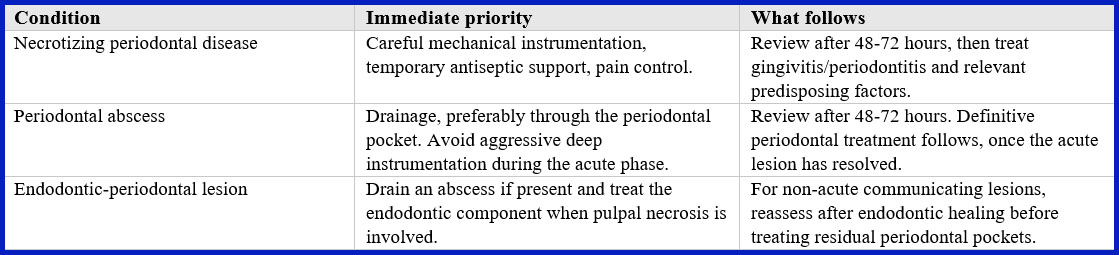
Across all three conditions, the same sequence runs through the guideline. First, confirm the diagnosis and relevant subtype. Second, control the acute condition—pain, infection, and continuing tissue destruction—using the least invasive effective intervention. Third, once the emergency has settled, manage the underlying disease, local aetiological factors, or patient-related predispositions.
That separation between emergency care and definitive treatment is important. It avoids doing too much during the most inflamed phase, clarifies when antibiotics are and are not justified, and creates a natural point for reassessment.
Necrotizing periodontal diseases: control the lesion, then the context.
Necrotizing gingivitis and necrotizing periodontitis are both characterized by papillary necrosis or ulceration, bleeding, and pain, while rapid bone loss distinguishes necrotizing periodontitis. If no obvious immune compromise is present, the clinician should actively look for relevant predisposing factors.
For patients with temporary or moderate immune compromise, the first-line intervention is careful mechanical instrumentation, preferably with sonic or ultrasonic instruments, to reduce the microbial burden while minimizing tissue trauma. Short-term antiseptic mouth rinses, such as chlorhexidine or hydrogen peroxide, may be used while normal plaque control is difficult. Oral hygiene should remain gentle during the acute phase, and pain should be managed without opioids.
The guideline suggests review after 48-72 hours. Once the acute lesion has resolved, attention shifts to the pre-existing gingivitis or periodontitis, modifiable factors (such as smoking, nutrition, and stress), and any residual soft-tissue sequelae.Periodontal abscesses: drainage before definitive instrumentation.
For periodontal abscesses, the central recommendation is straightforward: drainage is first-line treatment. Whenever feasible, drainage should be achieved through the periodontal pocket. This relieves pressure, reduces pain, and helps control destructive activity.
The guideline advises against mechanical instrumentation to the bottom of the periodontal pocket during the acute phase because viable periodontal ligament may still be present at the apical portion of the lesion. Definitive subgingival instrumentation belongs to the subsequent phase, once the abscess has subsided; the guideline notes that this is typically not until about 10-12 days from onset.
An early review after 48-72 hours is recommended. At the subsequent stage, underlying periodontitis should be treated according to current guidelines and contributing factors—such as foreign-body impaction, gingival enlargement, orthodontic factors, or alterations of the root surface—should be corrected.Endodontic-periodontal lesions: diagnosis and sequence matter
EPLs can be diagnostically demanding because pulp and periodontal tissues communicate and more than one pathology may be present. Deep periodontal pockets extending towards the apex and an altered or negative response to pulp testing are key diagnostic findings. Root fractures, cracks, perforations, and external root resorption must also be considered because they can change the prognosis.
When an acute EPL is driven by partial or complete pulp necrosis and the tooth is treatable, root-canal treatment should be the first step. If an abscess is present, drainage—preferably through the periodontal pocket and/or by incision—should be performed, followed by endodontic treatment. Immediate deep subgingival instrumentation is not recommended when an EPL presents with an abscess.
For non-acute communicating EPLs, the guideline suggests completing root-canal treatment first, allowing healing and reassessing after at least three months before treating a residual periodontal pocket. If a deep pocket of 6mm or more persists after endodontic and non-surgical periodontal therapy, periodontal surgery may then be considered.
Antibiotics: the exception, not the reflex
Antimicrobial stewardship is one of the clearest cross-cutting messages. Routine systemic antibiotics are not recommended for periodontal abscesses when adequate local treatment can be provided, and they should not replace drainage. Locally delivered antimicrobials are also not recommended for acute periodontal abscesses.
Systemic antimicrobials are reserved for defined situations: severe systemic involvement such as fever, malaise, or lymphadenopathy; a medical indication for antibiotic prophylaxis; or a situation in which adequate drainage cannot be achieved because of anatomical limitations or the characteristics of the abscess. In necrotizing periodontal disease, adjunctive systemic metronidazole may be considered when systemic signs are present.
The practical message is therefore not "never prescribe", but to treat the source locally whenever possible and prescribe only when the clinical or medical indication is clear.
The emergency visit is only the first step
Symptom relief is not the endpoint. After a necrotizing lesion has settled, an abscess has drained or an acute EPL has stabilized, the underlying problem still needs to be addressed. For patients with periodontitis, long-term supportive periodontal care is essential. Patients with a history of EPLs also need long-term follow-up to detect recurrence or late complications.
The value of the new guideline lies in this continuity. It connects emergency care to prevention and long-term tooth retention rather than treating the acute episode as an isolated event. Even where the certainty of evidence is low, the clinical logic is consistent: diagnose accurately, control the emergency, reassess early, use antibiotics selectively, and then treat the cause.
Bibliography
Dommisch H, Hoedke D, Dourou M, Calciolari E, Herrera D, Toma S. Management of periodontal abscesses and endodontic-periodontal lesions - a systematic review. Journal of Clinical Periodontology. 2026. doi:10.1111/jcpe.70135.
Duncan HF, Kirkevang LL, Peters OA, et al. Treatment of pulpal and apical disease: the European Society of Endodontology S3-level clinical practice guideline. International Endodontic Journal. 2023;56(Suppl 3):238-295.Herrera D, Papapanou PN, Chapple I, et al. Management of Acute Periodontal Conditions - The EFP S2k Level Clinical Practice Guideline. Journal of Clinical Periodontology. 2026. doi:10.1111/jcpe.70166.
Herrera D, Retamal-Valdes B, Alonso B, Feres M. Acute periodontal lesions (periodontal abscesses and necrotizing periodontal diseases) and endo-periodontal lesions. Journal of Clinical Periodontology. 2018;45(Suppl 20):S78-S94.
Montero E, Sanchez N, Zampa EP, et al. Management of necrotising periodontal diseases: a systematic review. Journal of Clinical Periodontology. 2026. doi:10.1111/jcpe.70118.
Sanz M, Herrera D, Kebschull M, et al. Treatment of stage I-III periodontitis: the EFP S3-level clinical practice guideline. Journal of Clinical Periodontology. 2020.
Biography

Selena Toma is programme director of postgraduate periodontology and implant dentistry at UCLouvain and head of periodontology at Cliniques universitaires Saint-Luc, Brussels. She is an elected member of the EFP executive committee and is also Belgium’s EFP delegate. Her clinical and research interests include periodontal and peri-implant diseases, peri-implantitis, osteoimmunology, nutrition, and host-related factors, as well as regenerative and minimally invasive periodontal therapy. She participated in the EFP guideline panel and co-authored the systematic review on periodontal abscesses and endodontic-periodontal lesions.
EFP partners








Sign up to our newsletter
The EFP publishes a free monthly email newsletter with the latest news about the federation's activities, its publications, and its campaigns.
