
Perio Insight, Clinical & Translational Research, Treatment, Article
How Perio Master Clinic 2026 showed importance of innovation and interdisciplinary thinking
23 April 2026
The EFP Perio Master Clinic 2026 brought together nearly 800 participants from 56 countries in Baku, Azerbaijan, for two days of intensive scientific sessions and discussions on the “perio-restorative interplay.” Orthodontist Kathrin Becker and periodontist Denica Kuzmanova work together at the University of Berlin as part of an interdisciplinary team, with cases that often involve the interplay of periodontal, orthodontic, and restorative factors. They pick their highlights of the event, which showed how profoundly the digital revolution and interdisciplinary thinking are reshaping clinical workflows and the management of complex perio-restorative cases.
Perio Master Clinic 2026, devoted to the “perio-restorative interplay”, featured seven thematic sessions and two video-based clinical-experience sessions that covered topics ranging from smile enhancement and the management of stage III/IV periodontitis to bone augmentation, recession treatment, and auto-transplantation. The event offered its participants innovations in clinical techniques, novel research findings, and insights on digital workflows, future technologies, and the use of artificial intelligence (AI).
Innovations in clinical techniques
Several presentations introduced noteworthy refinements to established surgical approaches. Markus Hürzeler (Munich) presented a modified vestibular incision technique for the treatment of stage III/IV periodontitis in the anterior maxilla. Using a strongly beveled incision from the vestibular side, a broad contact surface on the elevated flap is created. This allows suturing in four tissue layers—periosteum, muscle, connective tissue, and epithelium—following principles familiar from plastic surgery. In a retrospective analysis of cases treated with this approach, Hürzeler’s team reported 100% healing by primary intention, a marked improvement over the roughly 50% wound dehiscence rate described in earlier studies using closure techniques that are less layered. Hürzeler described this as a “game changer” for both periodontal stability and aesthetic outcomes in the anterior zone.
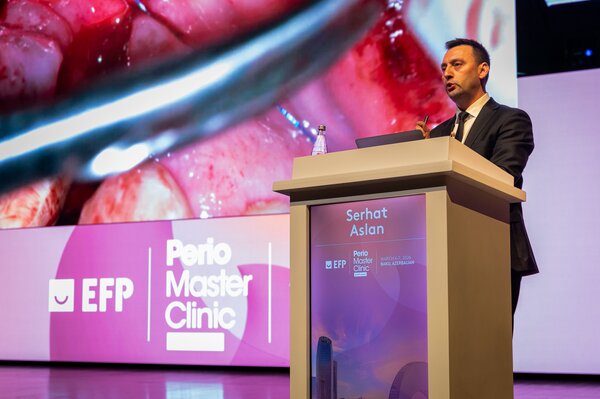
Serhat Aslan (Istanbul) reinforced the case for tooth preservation through regenerative strategies in severely compromised dentitions. He showed that careful flap design, which preserves the defect-associated papilla and avoids unnecessary incisions, combined with enamel matrix derivatives on a dry root surface can achieve stable pocket closure without scaffolding biomaterials. More than 50% of treated cases showed spontaneous papilla regrowth during supportive periodontal therapy. His concept of protecting anterior teeth with posterior implant support, rather than extracting the entire dentition, resonated strongly with the audience. (See “What are the challenges of using regenerative interventions to treat stage III/IV periodontitis in the anterior maxilla?”)
Paweł Plakwicz (Warsaw) offered a compelling session on auto-transplantation as a biological alternative to implants in younger, growing patients with anterior trauma. He presented long-term evidence demonstrating that transplanted premolars with open apices achieve periodontal healing rates above 90% and continue to follow alveolar growth while avoiding the infraocclusion that inevitably accompanies osseointegrated implants in young patients. His 20-year side-by-side comparison of a transplant and an implant in the same patient vividly illustrated the biological superiority of living tooth substitutes in this population.
Novel research findings
Otto Zuhr (Munich) opened the congress with a lecture on wound-healing biology. He emphasized that technique-related factors such as flap thickness, tension-free closure, and preservation of vascular supply, are the variables that clinicians can directly control to favour healing by primary intention. (See “Why good wound healing is crucial to the success of periodontal and implant surgery”)
From an orthodontic perspective, the session on complex ortho-perio cases was particularly relevant. Conchita Martin (Madrid) presented randomized controlled trial (RCT) data on the effects of orthodontic tooth movement in periodontally compromised patients, confirming that tooth movement under controlled periodontal conditions does not lead to additional attachment loss. Her group advocates initiating orthodontic treatment as early as possible after regenerative surgery, taking advantage of the regional acceleratory phenomenon, provided infection is controlled and periodontal ligament biology has recovered.
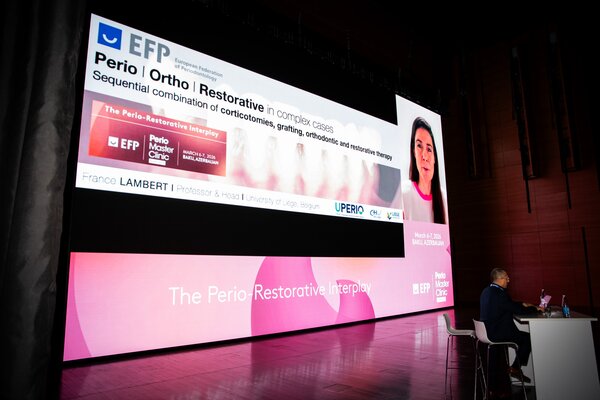
France Lambert (Liège) demonstrated how minimally invasive piezoelectric corticotomies (Piezocision), harnessing the regional acceleratory phenomenon (RAP) and optionally combined with buccal β-TCP augmentation, shorten adult orthodontic treatment by about 45%, from 18 to 10 months. She emphasized that digital planning integrating cone-beam computerized tomography (CBCT) has become essential for periodontally compromised or thin-phenotype cases, minimizing virtual bone dehiscences via 3D root-alveolar visualization and proactive grafting.
Digital workflows, future technologies, and use of AI
Digital transformation was a major theme at the congress. Eric Van Dooren (Antwerp) demonstrated how a centralized digital workflow using SmileCloud software has fundamentally changed crown-lengthening procedures. Rather than following the traditional linear sequence of orthodontist, periodontist, then restorative dentist, his team now selects a single biometric tooth form from a digital library at the start of treatment and maintains it throughout all steps. Crown lengthening is performed without a flap, guided by a 3D-printed surgical guide, with piezoelectric instruments used for closed-flap osseous resection. Final monolithic restorations are bonded within 48 hours, enabling prosthetically guided tissue healing. Van Dooren reported that about 80% of his cases are now performed without flap elevation, marking a clear departure from the open-flap dogma that dominated the field for decades. Only minimal tissue rebound was observed over a two-year follow-up.
Truly interdisciplinary thinking
Perio Master Clinic 2026 made clear that the successful treatment of complex perio-restorative cases depends on truly interdisciplinary thinking from the outset. For orthodontists in particular, three messages stood out:
- Digital planning tools now make it possible to guide tooth movement within the delicate alveolar envelope with unprecedented precision.
- Regenerative periodontal surgery is redefining the limits of tooth preservation.
- The shift from linear to centralized, digitally integrated workflows is improving predictability while reducing invasiveness and enhancing the patient experience.
The next Perio Master Clinic in Athens (2029) and EuroPerio12 in Munich (2028) will likely continue to advance this momentum.
Digital planning and hybrid approach shorten treatment time
In her own presentation in Baku, Kathrin Becker presented results from a multicentre RCT evaluating the accuracy of aligner therapy, showing that molar distalization and intrusion achieve only around 50% of planned movements. She said that this finding highlighted the limitations of the sole use of aligners in advanced periodontal cases that require significant vertical correction.
Professor Becker also outlined how CBCT-based digital planning enables three-dimensional risk assessment of root positions relative to the bony envelope before orthodontic movement begins, which is a critical safety measure in a reduced periodontium. She described a hybrid treatment concept that combines, in parallel, skeletal anchorage with custom metal-printed appliances for difficult movements—such as molar intrusion—and aligners for simpler tasks. This approach can substantially shorten treatment time. Looking ahead, she identified AI-assisted root-and-bone segmentation, patient-specific force prediction, and real-time treatment planning as emerging technologies that may further individualize orthodontic care in compromised patients.
Biographies
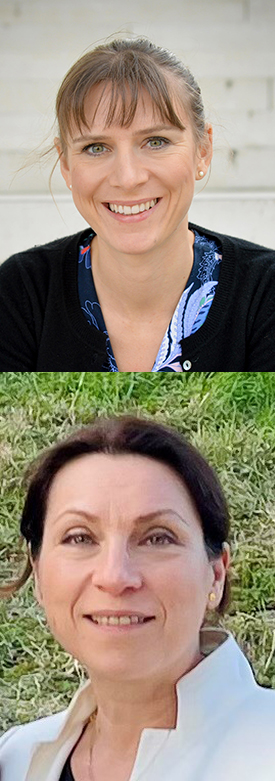
Kathrin Becker is director of the Department of Orthodontics and Dentofacial Orthopaedics at Charité—Universitätsmedizin Berlin. She studied dentistry and computer science and obtained her doctorate at Heinrich Heine University Düsseldorf, where she also completed her specialist training in orthodontics. Professor Becker is editor-in-chief of Informationen aus Orthodontie & Kieferorthopädie, editor-in-chief of Clinical and Experimental Dental Research, and section editor of the Journal of Orofacial Orthopaedics. Her research focuses on digital and individualized orthodontics, including artificial intelligence, CAD-CAM-based workflows, skeletal anchorage, and advanced dental imaging.
Denica Kuzmanova is assistant professor and clinical course co-ordinator at the Department of Periodontology, Oral Medicine and Oral Surgery at Charité—Universitätsmedizin Berlin. She studied dentistry and obtained her doctorate at the University of Hamburg. She completed her postgraduate specialist training in periodontology and oral implantology as well as her MSc in periodontology at ACTA, University of Amsterdam. Dr Kuzmanova’s clinical and research interests focus on periodontal therapy, peri-implantitis treatment, the systemic effects of periodontal disease, modifying risk factors, and the role of nutrition in periodontal health.
EFP partners









Sign up to our newsletter
The EFP publishes a free monthly email newsletter with the latest news about the federation's activities, its publications, and its campaigns.
