

Issue No. 153
Summarized from Journal of Clinical Periodontology, Volume 53, Issue 9, September 2026, 1481-1490
Editor: James Deschner, chair, EFP scientific affairs committee
Residual pockets and furcation involvement may predict tooth loss during supportive periodontal care
Authors: M. Cyris, P. Bartels, M. Kahl, C. Springer, S. Sälzer, K. Fawzy El-Sayed, C. E. Dörfer, Li-Li Zhou, C. Graetz
Background
Periodontitis is among the world’s most prevalent chronic inflammatory diseases and, if left untreated, ultimately results in tooth loss. Contemporary management consists of active periodontal treatment (APT) followed by individualized supportive periodontal care (SPC), as outlined in the EFP S3-level clinical practice guidelines.
SPC effectively controls disease progression and is consistently identified as the main determinant of long-term periodontal stability. Deep residual probing pocket depths (PPD) and advanced (degree II–III) molar furcation involvement have been associated with an increased risk of tooth loss. The 2018 classification of periodontal diseases, on which the EFP guidelines are based, accordingly incorporated PPD, bone loss, and furcation involvement into its framework of disease stages.
However, direct evidence linking baseline disease severity to tooth loss over long SPC periods remains limited, as most longitudinal studies last only between five and 15 years. Therefore, historical cohorts followed continuously for decades under real-life conditions offer a rare opportunity to examine these relationships.
Aim
To quantify tooth loss in patients maintained under SPC for more than 30 years in a university setting and to identify clinical predictors of tooth loss, with particular emphasis on residual disease severity at APT completion, expressed as the proportion of teeth with PPD ≥6mm and the number of molars with advanced furcation involvement.
Materials and methods
- Retrospective cohort study at the department of periodontology of the University of Kiel, Germany, using a periodontal database kept since 1982.
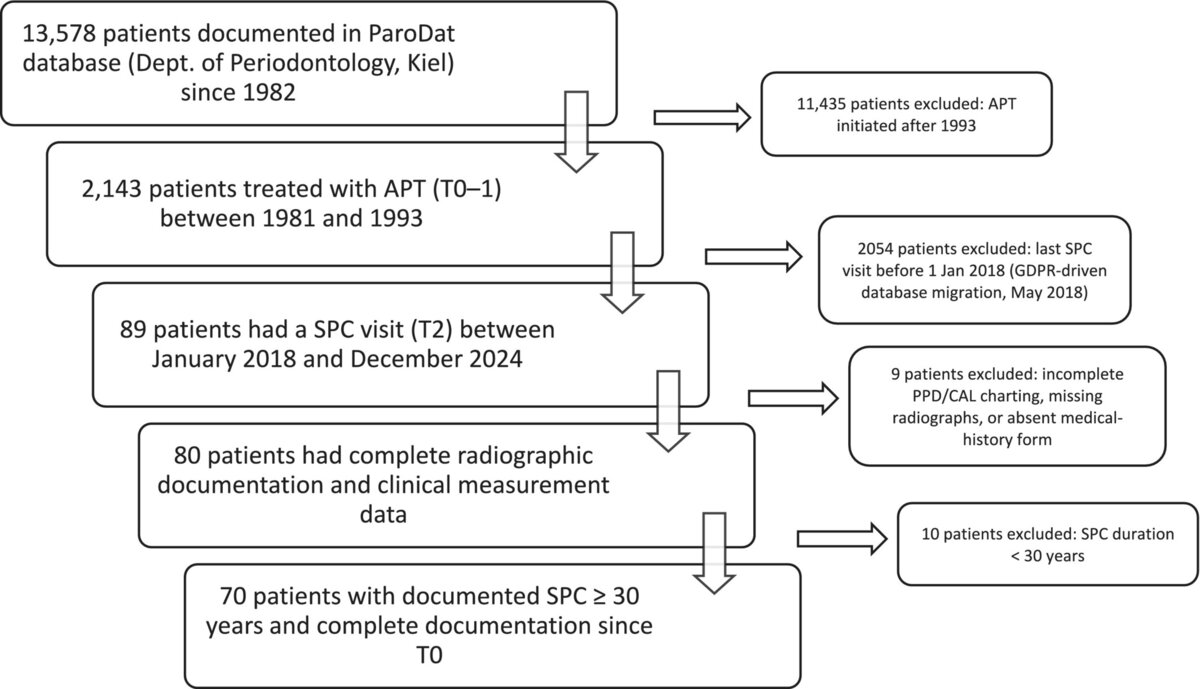
- Inclusion criteria: APT between 1981 and 1993, ≥30 years of SPC with regular clinical and radiographic documentation, sufficient baseline data for a 2018-classification diagnosis, and a most recent SPC visit between 2018 and 2024.
- Of 2,143 patients treated with APT between 1981–1993, 70 (3.3%) met all the criteria.
- Time points: T0 (start of APT), T1 (end of APT/start of SPC), T2 (most recent SPC visit).
- APT: non-surgical root debridement and, when indicated, access-flap surgery, adjunctive systemic antibiotics (amoxicillin, metronidazole), endodontic treatment, splinting, or molar root resection.
- SPC: individualized recalls (between three and 12 months) with remotivation, oral-hygiene instruction, and professional mechanical plaque removal (PMPR); sites with PPD ≥5mm and bleeding on probing (BOP) were subgingivally reinstrumented; non-responding sites were considered for surgery.
- Variables (T0, T1, and T2, unless otherwisestated): gender, age, number of missing teeth, number of teeth lost during APT and SPC, smoking, diabetes, six-site PPDs, clinical attachment levels (CAL), and radiographic bone loss (T0, T2), furcation involvment per molar, disease extent, stage and grade, and SPC adherence.
- SPC adherence was considered sufficient when the longest recall gap was ≤32 months.
- Stability at T2 followed the EFP guideline criteria.
- Statistics:
- Patient level: negative binomial regression of teeth lost per year of SPC, adjusted for age, smoking, and adherence, giving incidence rate ratios.
- Tooth level: Cox model (1,792 teeth; 217 dated extractions, 105 undated but imputed in a sensitivity analysis), giving hazard ratios and Kaplan–Meier survival curves.
- Sensitivity, specificity, and positive predictive value of baseline markers.
Results
- Seventy patients, 97% with stage III or IV periodontitis, received supportive periodontal care (SPC) for a mean of 36.1±2.9 years (range: 30-43 years).
- During SPC, 63 patients lost 322 teeth: 4.6±4.2 teeth per patient, or 0.13±0.12 teeth per patient-year. Molars represented half of all extractions (161/322), while seven patients lost no teeth.
- Periodontal status improved substantially. Mean probing pocket depth declined from 5.19mm at T0 to 3.82mm after active treatment (T1) and 3.36mm at the final review (T2) at patient level. The mean number of teeth with deep pockets (PPD ≥6mm) per patient decreased from 10.6 (T0) to 3.9 (T1) and then to 0.8 (T2).
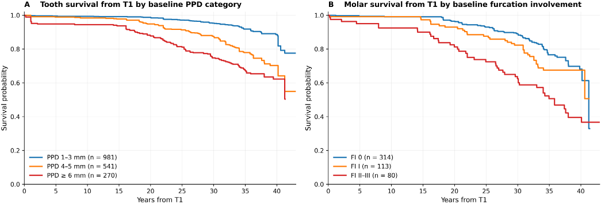
- Deep pockets at the start of SPC remained clinically important. During maintenance, 35.9% of teeth with PPD ≥6mm were lost, compared with 24.2% of teeth with PPD 4-5mm and 9.6% of teeth with PPD 1-3mm.
- Molar retention was also associated with furcation involvement. During SPC, 73.9% of molars without furcation involvement and 69.0% with grade I involvement survived, compared with 51.1% and 36.4% of molars with grade II and grade III involvement, respectively.
- After adjustment for age, smoking, and adherence, a greater proportion of teeth with PPD ≥6mm and more molars with advanced furcation involvement were associated with a higher rate of tooth loss. However, their predictive value at an individual-tooth level was modest, indicating increased population-level risk rather than certain tooth loss.
Limitations
Several limitations must be considered when interpreting these findings. Most notably, the study features a pronounced survivorship bias, as only 3.3% of the initially eligible cohort completed more than thirty years of maintenance, which heavily restricts the ability to generalize about the outcomes beyond specialist university settings.
Furthermore, the study's definition of "sufficient adherence" to supportive periodontal care (SPC) permitted recall gaps of up to 32 months. This is exceptionally lenient compared to the standard, individualized recall intervals of between three and 12 months for maintaining periodontal stability that are recommended by the EFP’s S3-level clinical practice guidelines.
The retrospective design precludes causal inference, and because the reasons for extraction were often multifactorial or unrecorded, tooth loss cannot be strictly attributed to periodontitis alone. In addition, an administrative selection bias was introduced by excluding patients whose last visit occurred before a 2018 database migration.
Finally, the cohort lacked a never-smoker group, and potentially critical confounders over the three-decade observation period—such as changes in systemic health and parafunctional habits—were not assessed.
Conclusions and impact
- Supportive periodontal care is highly effective at preserving the dentition over multiple decades, even for patients who initially presented with advanced periodontitis
- Residual disease indicators at the start of maintenance—specifically probing depths of 6mm or more and advanced furcation involvement—serve as population-level predictors of future tooth loss
- However, these baseline severity markers are not deterministic. Many severely compromised teeth survived long-term, highlighting the necessity for continuous, tooth-specific clinical re-evaluation, rather than assuming inevitable tooth loss.
- When tooth loss did occur during extended maintenance, it tended to present as clustered late events. This pattern likely reflects the natural limits of tooth retention in ageing patients rather than an immediate failure of periodontal therapy.
- These remarkably positive long-term outcomes reflect a highly compliant, selectively retained university cohort and should not be directly extrapolated to general-practice populations.
Clinicians should prioritize achieving optimal disease control before transitioning patients to maintenance, as residual deep pockets and advanced furcation involvement significantly elevate long-term tooth loss risk. However, because these baseline markers are not deterministic, treatment decisions must rely on continuous, tooth-specific clinical re-evaluation rather than the initial severity alone.
Rapporteurs: Tina Lipovec, Yuko Kurushima, Melissa Shemie and Wasim Idoo, supervised by Professor Luigi Nibali
Affiliation: Postgraduate programme in periodontology, King's College London, UK
With kind permission from Wiley Online Library. Copyright © 1999-2026 John Wiley & Sons, Inc. All rights reserved
EFP partners









Sign up to our newsletter
The EFP publishes a free monthly email newsletter with the latest news about the federation's activities, its publications, and its campaigns.
