
Publications Hub, Topic, Treatment, Article
The EFP Probe will help dentists with diagnosis and implementation of clinical-practice guidelines
27 March 2026
At present, periodontists use different probes for screening and for treatment, and the screening probe is calibrated with out-of-date thresholds. The EFP Probe, launched at EuroPerio11 last year and now being deployed by the federation’s national societies, is a single probe for screening and treatment, designed to facilitate diagnosis according to the current classification of periodontal disease and the EFP’s clinical practice guidelines. Moritz Kebschull, past president of the EFP, explains the origins and development of what could become an essential tool for dental professionals.
What is the EFP Probe? What does it do that conventional probes do not do?
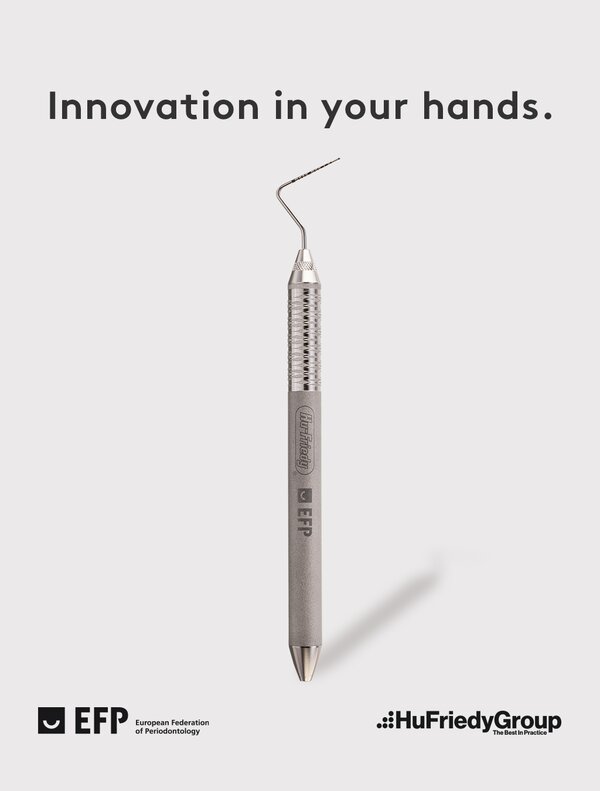
We have two different probes in periodontology: a screening probe and a treatment probe. For screening, traditionally it is the WHO probe, based on the World Health Organization’s Community Periodontal Index of Treatment Needs (CPITN), which was then adopted by national periodontal screening indices, such as the as the British Periodontal Examination (BPE) in the UK, the Periodontal Screening and Recording (PSR) in the USA, and the periodontal screening index (PSI) in Germany.
They all use this screening probe to check whether there is a need for treatment. It has a ball tip and bands that tell you what the treatment need is. The thresholds indicated by the bands are 3.5mm and 5.5mm, based on a paper from 1982 about critical probing depth by one of the leaders in our field, Jan Lindhe. But we are now in 2025 and use different thresholds in our classification and guidelines.
Then there are treatment probes for measuring to the nearest millimetre. The most-used probe is the UNC 15, which we use for periodontal, implant, and recession treatment. With this probe you can measure things like recessions very nicely, but it can be confusing to use because it has 15 bands (from 1mm to 15mm).
We presented the probe at EuroPerio11 where there was massive interest from the crowd. We have since presented it to our accredited postgraduate programmes and our national societies, which will provide it to their members.
Initially we considered calling it the S3 Probe, following the S3 guideline process. But then we decided that, as it is something that follows all our guidelines and implements, we should call it the EFP Probe. When we chose a slogan for the campaign to promote the EFP Probe we opted for “Putting Classification and Guidelines into practice.”
How much easier or quicker will it be for the clinician using this tool, whether in diagnosis or in treatment, than in using the current probes?
The first thing is that this product can be used for screening. You can see right away whether, according to the guidelines, you have a healthy situation, a situation that may require non-surgical therapy, or a situation that may need surgical therapy. That will make it easier. We have 1mm, then 3mm (which is healthy), 4mm (which could mean stable in treated patients or the beginning of the need to do treatment), then 5mm and 6mm as a threshold.
At the same time, you can use the probe for everything you would use a normal probe for. It is like a normal periodontal probe that has all the attributes that it needs to have. It also has the ball tip that allows us to check for overhangs and plaque factors, which is a good thing at all stages of periodontal therapy.
How was the EFP Probe developed and tested?
After the worldwide classification in 2018 and putting together the three EFP S3-level clinical practice guidelines, we are now focused on their implementation in Europe and beyond. I was discussing this with Nicola West and Iain Chapple (both former EFP secretaries general and, like Moritz Kebschull, members of the British Society of Periodontology), and we all felt it was a bit illogical to use probes that are linked to thresholds that come from paper that is more than 40 years old rather and which involved very few patients than to the thresholds defined by the classification and the guidelines.
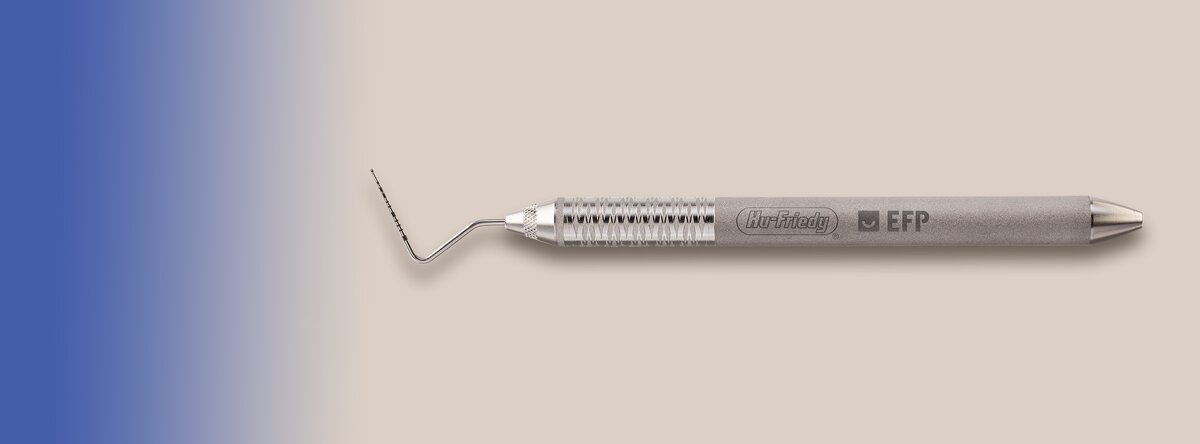
For scientific and clinical reasons, we thought it would help the implementation of our guidelines to have a probe that unifies the screening and treatment probes into one product—so you no longer need two probes—and changes the thresholds slightly to match the classification. What you have is a UNC 15 fused with a WHO probe, but with bands at 4mm and 6mm rather than 3.5mm and 5.5mm.
Then we had to find somebody to make it. So, we teamed up with HuFriedyGroup, the biggest and most reputable manufacturer in dental probes worldwide and asked them for collaboration that is not protected as a brand mark. The EFP branding is a deal between the manufacturer and the EFP. But it is not an exclusive deal, and I can envisage that this probe will be copied. We are privileged to working with HuFriedyGroup and we are very happy that they have partnered the EFP for this product.
We had a multi-step design process and then field testing. After the field testing, the 2mm band was removed because it confused a lot of the users. We looked at typical usage and the 2mm band is the one that you need the least. If you can measure 1mm and 3mm, you can extrapolate 2mm if you need to. But 2mm is not deep enough to be meaningful for recession and it is not a meaningfully deep pocket because everything I need to know for whether a pocket represents periodontal health is that it is 3mm or less.
So, there are 14 bands on the probe (from 1mm to 15mm, skipping 2mm) and a lot of work was done to make sure that these bands last a long time. I would have liked to have had colours to make it easier to distinguish measurements, but colours wear off. If you want a probe with coloured bands, you would need to make it in plastic, which has many downsides: it would be weaker, it would not last so long, it would be thicker and bendier, and measurements could be distorted.
To sum up, the whole world uses the UNC 15, which has been tried and tested, and this is a new improved version. I think it gives us the best of all worlds. It gives us fantastic screening, the easy implementation of the classification and the guidelines, and it allows us to measure everything we typically want to measure without confusing us too much.
Where does it go from here?
After the well-received launched at EuroPerio11, the EFP national societies and accredited programmes have started to introduce the probe and support dentists in its use. By incorporating the EFP Probe into its postgraduate programmes, the EFP is helping to prepare professionals with innovative and evidence-based instruments, reflecting the federation’s commitment to clinical excellence and education. Its cost is comparable to a standard probe, and replacing two separate instruments with a single tool may also offer practical advantages
Biography

Moritz Kebschull, who was president of the EFP in 2024-25, holds the chair of restorative dentistry at the University of Birmingham in the UK and an adjunct professorship at Columbia University in New York, USA. He co-chairs the annual EFP workshops and drives the development of high-quality clinical practice guidelines in periodontology and other dental disciplines.
EFP partners









Sign up to our newsletter
The EFP publishes a free monthtly email newsletter with the latest news about the federation's activities, its publications, and its campaigns.
