
Clinical & Translational Research, Article
What clinicians need to know about how PTSD can affect dental health
11 November 2026

The relationship between dental and mental health is underexplored and professionals in both fields need to be more aware of the links and the therapeutic steps they should take. Proper assessment of oral health needs to be included in inpatient care in psychiatric hospitals while dentists need training in how best to handle vulnerable patients. Thomas Eger and Anne Wolowski, members of the German Society of Dentistry and Oral Medicine’s working group on psychology and psychosomatics, discuss the issues in relation to post-traumatic stress disorder (PTSD).
In psychiatric wards in hospitals around the world, assessing the oral health of patients with severe mental-health conditions is not part of routine examinations. But this kind of assessment is crucially important for four reasons.
- Patients may be suffering from poor oral health when they are admitted.
- Their oral health may deteriorate because of a multitude of systemic complications and the time lost in the treatment of severe psychiatric conditions.
- The administration of antipsychotic and tricyclic medication, which is generally necessary, often provokes a dry mouth and therefore an increased risk of caries and periodontitis.
- Side effects of the medication can produce painful orofacial functional disorders that require treatment. The consequences include more untreated caries, periodontitis and—in extreme cases—tooth loss. In cases that also involve substance abuse, the effects are exacerbated (see Figure 1).
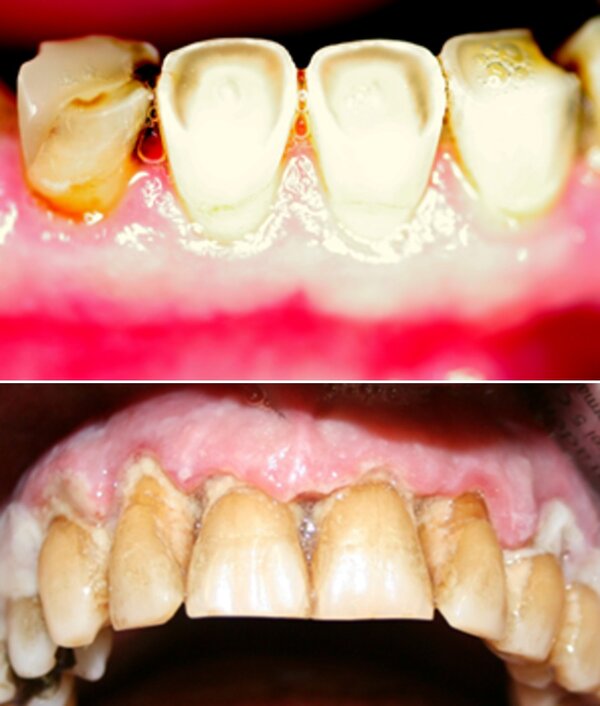
One psychiatric condition that presents specific challenges in relation to periodontal health is post-traumatic stress disorder (PTSD), which manifests as a complex psychological reaction to one or more traumatic events experienced through direct involvement, witnessing, or exposure to extreme events. PTSD is generally understood as the body’s attempt to cope with a traumatic, often life-threatening, situation through counter-regulatory mechanisms.
Unlike the acute stress reaction, which is aimed solely at survival, PTSD leads to long-term psychological and physical impairment. There may also be a delayed onset, where the full range of symptoms only becomes apparent six months or more after the trauma.
The clinical picture is characterized by clusters of symptoms that persist for more than one month and lead to significant functional impairment: intrusive thoughts, avoidance behaviour, negative changes in cognition and mood, and hypervigilance. Those affected suffer from recurrent, uncontrollable, and distressing memories of the trauma, which manifest as flashbacks, nightmares, or intense physical and psychological reactions when confronted with trauma-associated stimuli. Complex PTSD is characterized by multiple traumatic events and the resulting combined clinical presentations.
Estimates of the prevalence of PTSD vary between two and ten percent on veterans. The latest estimate from the World Health Organization is that an estimated 3.9% of the world population has had PTSD at some stage in their lives.
In relation to dentistry, PTSD patients may have a fear of blood and injury, memory impairment, an increased prevalence of clinically significant dental anxiety (CDSA) that may include avoidance behaviour lasting more than two years, dentine hypersensitivity, and heavy tobacco use as a coping mechanism, which increases the risk of periodontitis. Bruxism, restricted mouth opening, and painful temporomandibular dysfunction (pTMD) are also significant problems in PTSD patients.
A group of Norwegian researchers from Oslo and Kristiansand has been examining and treating refugees from the Middle East and Africa since 2019. The objectively assessed dental-treatment requirements among those examined differed little from those of the Norwegian population. However, the CSDA was 6.1 times higher among refugees who had personally experienced violence compared with other refugees, and 9.3 times higher among patients who had subsequently developed PTSD (Høyvik et al., 2019).
As the treatment of orofacial functional disorders is minimally invasive and can significantly alleviate suffering, it is recommended that people with PTSD and temporomandibular joint pain or masticatory muscle pain be referred for dental assessment—even if they have an additional CSDA—in order to arrange adjuvant dental therapy for pTMD, where appropriate.
Therapy with dental reflex splints has been shown to lead to a reduction in temporomandibular joint/masticatory muscle pain, a reduction in nightmares, and an increase in the duration of uninterrupted sleep. The therapeutic reduction in TMD pain achieved through splint therapy in PTSD patients is maintained over long periods, even if the PTSD persists (Woerner et al., 2024.
The relationship between periodontitis and PTSD
Periodontitis is regarded as a multifactorial chronic inflammatory disease, the development of which is influenced by both microbial factors and systemic and immunological factors. Through elevated levels of IL-6 and CRP that cross the blood-brain barrier, inflammatory periodontal diseases can influence neurotransmitter metabolism, neuroplasticity, and the stress-response system in mental-health conditions.
Against this background, the investigation of PTSD as a potential risk factor for periodontal disease, and vice versa, is of increasing clinical relevance. A study of Croatian war veterans showed that patients with PTSD had significantly higher plaque and bleeding indices compared with a healthy control group and patients with severe periodontitis. The prevalence of the periodontal pathogens Actinobacillus actinomycetemcomitans, Porphyromonas gingivalis and Eikenella corrodens was similarly high in PTSD patients without periodontitis and in patients without PTSD but with severe periodontitis. This led to the conclusion that people with PTSD should be classified as a risk group for the development and progression of periodontal disease (Haban et al., 2003).
One study has found both increased tobacco use and a higher prevalence of severe periodontitis (stages III/IV) in the group of military veterans with PTSD (Tagger-Green et al., 2022). Another study found no significant differences in the prevalence of periodontitis of any severity level between veterans with PTSD and a control group without PTSD who had comparable lengths of overseas deployment and were of similar ages (Wörner et al., 2021). It is possible that regular dental check-ups and supportive periodontal therapy, as protective factors within the military system, offset smoking as a modifiable risk factor.
Akinkugbe et al. (2025) investigated the long-term oral health consequences of traumatic events following the terrorist attacks of 11 September 2001 over a follow-up period of up to 17 years. The results showed an incidence rate of periodontitis of 7.6 per 1,000 participants among those with PTSD, compared with 4.3 per 1,000 in participants without PTSD. After adjusting for relevant covariates, there was a 52% increased risk of periodontitis in patients with PTSD. Furthermore, PTSD was also associated with an increased risk of tooth loss.
People with PTSD should be classified as a risk group for developing periodontal disease
A recent systematic review comprising 13 studies involving 1,610 patients used a meta-analysis to establish that, following periodontal therapy and three months of supportive periodontal care, patients with stress-related disorders or depression achieved 1mm less gain in periodontal tissue compared with mentally healthy patients (Mauland and Neupane, 2025). Another recent review identified significantly greater residual periodontal inflammation following periodontal therapy in these patients across eight studies (Villafuerte et al., 2025).
Hamid and Dashash (2019, 2021) investigated the link between PTSD and periodontal health in refugee children. In their case-control study, 60 children aged between nine and 14 were examined during the Syrian civil war (2011-2014): 30 with a diagnosis of PTSD and 30 healthy control subjects. The results showed significantly higher values for both the plaque index and the gingival index in the traumatised children (P < 0.0001). Furthermore, the severity of PTSD symptoms correlated positively with plaque accumulation and signs of gingival inflammation.
As part of a six-week oral-hygiene training programme held twice a week in a refugee camp, researchers found significant differences between children in the intervention group and those in the control group who received no oral-hygiene training. Among other things, the authors discuss behavioural factors such as impaired oral hygiene in the context of psychological distress, changes in stress regulation, and reduced access to dental care in crisis areas as possible mechanisms. The study thus demonstrates that traumatic stress experienced as early as childhood may be associated with a deterioration in periodontal health.
Links between PTSD and periodontal health in refugee children
Compared with baseline measurements, children in the intervention group had significantly lower:
- plaque index (1.52 ± 0.55 vs 1.89 ± 0.39).
- gingival index (1.48 ± 0.56 vs 2.14 ± 0.32).
- PTSD score (CPQ11-14: 47.16 ± 12.24 vs 72.65 ± 14.47).
- CPTSD-RI* (34.41 ± 12.23 vs 47.91 ± 14.24).
Children in the control group showed no significant changes in any of these parameters (p > 0.05).
(* CPTSD-RI: children’s post-traumatic stress disorder reaction index)
Trauma-informed care in dentistry
Poor oral hygiene in the absence of dental care, coupled with dental anxiety requiring treatment and, in many cases, significant tobacco use characterize the oral health and disease of PTSD patients prior to their first inpatient psychiatric treatment.
The costly consequences of non-treatment make specialized healthcare appropriate for these vulnerable individuals, ensuring that re-traumatization caused by medical and dental surgical procedures (including flashbacks of traumatic events and nightmares) is avoided. Patient education, participatory decision-making, consideration of individual preferences, and case management are general principles of medical care that must be given particular attention when providing dental treatment to this vulnerable group of patients with PTSD.
In particular, the patient interview conducted when taking a medical history in a dental practice—which may involve questions about experiences of violence and torture (for example, based on visible scars, or where PTSD is suspected) carries the risk of re-traumatisation if patients come into contact with a member of staff who, while willing to help, lacks the necessary sensitivity.
Dentists need training in trauma-informed care for working with patients with PTSD
When taking a medical history, it is important to convey that knowledge of the patient’s history of trauma is essential to understanding their current pain and other symptoms. Training in trauma-informed care (TIC) for dentists on how to deal with these vulnerable patient groups is advisable, given the significant time required before treatment begins and during treatment as a result of the need for to extensive pre- and post-treatment consultations.
The application of dental communication techniques based on TIC (usually over up to five treatment sessions) for the treatment of patients with clinically significant dental anxiety—where treatment typically begins with a dental examination followed by a dental clean—demonstrates significant anxiety-reducing effects both post-treatment and during follow-up. The ‘Four-Habits Model’ for encounters with patients has been shown to result in low levels of avoidance behaviour towards dental treatment in the long term.
Mental-health questionnaires can also be used by dentists, provided they explain why such a questionnaire is being used in a dental practice. If the results of the questionnaire show that defined thresholds are exceeded, dentists may propose a referral for psychiatric treatment, provided that, for example, an appointment can be secured within 24 hours. This must be clarified in advance and assistance provided where necessary.
Conclusion
Dental care for people with PTSD is essential. In this context, interdisciplinary liaison with the general practitioner and, where appropriate, psychotherapists, are important, along with a coordinated approach. In any case, it is helpful if the entire dental team is trained in dealing with these traumatized patients. Treating the underlying traumatic stress can help to improve somatic symptoms.
A significant contribution to reducing suffering can be achieved, in particular, through the treatment of functional disorders and the preservation of teeth. Particularly in times of international migration and armed conflicts involving the displacement of large population groups, knowledge in this area is of great importance for healthcare provision.
Bibliography
Akinkugbe, A. A., Midya, V., Crane, M. A., Garcia, D. T., Clark, U. S., & Wright, R. J. (2025). Long-Term Oral Health Effects of Traumatic Events Among World Trade Center Health Registry Enrolees, 2003–2020. Community Dentistry and Oral Epidemiology, 53(2), 170–179.
Carter, A.E. (2026). A Case for Psychostomatology – To explore the implementation and design of dedicated dental care units for psychiatric patients. Winston Churchill Memorial Trust. https://www.churchilltrust.com.au/fellow/ava-carter-act-2024/
Haban, V., Aurer, A., Ivić-Kardum, M., Mravak-Stipetić, M., Gall-Trošelj, K., & Aurer-Koželj, J. (2003). Post-Traumatic Stress Disorder Patients and Periodontal Health. Acta stomatologica Croatica: International journal of oral sciences and dental medicine.; 37 (3),328-329.
Hamid, S. H., & Dashash, M. A. D. (2019). The impact of post-traumatic stress disorder on dental and gingival status of children during the Syrian crisis: A preliminary study. Journal of Investigative and Clinical Dentistry, 10(1), e12372.
Hamid, S., Dashash, M., & Latifeh, Y. (2021). A short-term approach to promoting oral health in internally displaced children with PTSD: the key is improving mental health – results from a quasi-randomised trial. BMC Oral Health, 21(1), 58.
Høyvik, A. C., Lie, B., & Willumsen, T. (2019). Dental anxiety in relation to torture experiences and symptoms of post-traumatic stress disorder. European Journal of Oral Sciences, 127(1), 65–71.
Mauland, E. K., & Neupane, S. P. (2025). The influence of psychological stress and stress-related disorders on the treatment outcome of periodontitis: a systematic review and meta-analysis. Journal of Clinical Periodontology, 52(12), 1760–1778.
Tagger-Green, N., Nemcovsky, C., Fridenberg, N., Green, O., Chaushu, L., & Kolerman, R. (2022). Oral and Dental Considerations of Combat-Induced Post-Traumatic Stress Disorder (PTSD): A Cross-Sectional Study. Journal of Clinical Medicine, 11(11), 3249.
Villafuerte, K. R. V., Palucci Vieira, L. H., Santos, K. O., Rivero-Contreras, E., Lourenço, A. G., & Motta, A. C. F. (2025). Psychological Stress Reduces the Effectiveness of Periodontal Treatment: A Systematic Review. Journal of Clinical Medicine, 14(5), 1680.
Wörner, F., Eger, T., Simon, U., Becker, A., & Wolowski, A. (2024). Lifespan of Splints in a Sample of German Soldiers Hospitalised with Post-traumatic Stress Disorder (PTSD) in Combination with Sleep Bruxism and Painful Temporomandibular Disorder (TMD). Oral Health & Preventive Dentistry, 22, 249–256.
Wörner, F., Eger, T., Simon, U., & Wolowski, A. (2021). Periodontal Disease and Tooth Wear in a Sample of German Soldiers with Post-traumatic Stress Disorder. Oral Health & Preventive Dentistry, 19, 449–456.
Biographies

Thomas Eger (Colonel retired) was clinical director of the Department of Dentistry and Periodontology and programme director of the German military’s thee-year training for specialists in periodontology at the German Armed Forces Central Hospital in Koblenz. His continuously military-funded research programme over the past 40 years has focused on oral and periodontal anti-infective medicine, perio-prosthetics and the trauma associated psychosomatic aspect of dentistry. He has published more than 100 papers, textbook chapters on periodontology, and oral-health research. He has served as chair of the Working Group on Psychology and Psychosomatics in the German Society of Dentistry and Oral Medicine (DGZMK).
Anne Wolowski is the lead senior physician at the Department of Prosthetic Dentistry and Biomaterials of the University of Münster. She is a specialist in prosthetics as well as functional diagnostics and therapy. She is secretary general of the German Society of Dental, Oral, and Craniomandibular Sciences (DGZMK) and president of the German Society for Prosthetic Dentistry and Biomaterials. From 2006 to 2025, she was chair of the Working Group on Psychology and Psychosomatics within the DGZMK. She is the author of more than 400 publications in peer-reviewed journals and books and the editor of two books.
EFP partners








Sign up to our newsletter
The EFP publishes a free monthly email newsletter with the latest news about the federation's activities, its publications, and its campaigns.
