
Classification & Guidelines, Clinical & Translational Research, Article
What do clinicians need to know in treating periodontitis and periodontal conditions in systemically healthy children and adolescents?
18 September 2026
The consensus report of the focused workshop organized by the EFP and the European Academy of Paediatric Dentistry (EAPD) on gingival and periodontal diseases in children and adolescents was published in the July 2026 issue of the federation’s Journal of Clinical Periodontology. At the workshop, three working groups considered systematic reviews and developed their consensus view. Sotiria Gizani co-chaired the workshop and the working group that explored periodontitis and periodontal conditions in systemically healthy children and adolescents. She outlines the evidence and the consensus report’s recommendations.
Our working group addressed the epidemiological characteristics of periodontitis, as well as diagnostic, preventive, and therapeutic strategies for systemically healthy children and adolescents. Available evidence on other periodontal conditions—including necrotizing periodontal diseases (NPDs), mucogingival conditions (particularly gingival recession), periodontal abscesses, and endodontic-periodontal lesions—was also reviewed.
A total of 5,389 publications were identified, of which 205 relevant articles were included in the final review. Most of the available evidence concerned periodontitis, while considerably fewer studies examined mucogingival conditions, NPDs, and periodontal abscesses. There was essentially no evidence addressing some of the other periodontal conditions originally included in the review question. Most of the included studies were considered to have a high risk of bias, and the overall certainty of the evidence was rated as very low. This was largely attributable to substantial differences in diagnostic definitions, study populations, and methodological approaches. These limitations may partly explain the considerable variation in the reported prevalence of periodontitis among young populations, which ranged from 0.1% to 30.6%. However, most studies reported prevalence rates below 2%.
The review highlighted that some forms of periodontitis in adolescents may exhibit surprisingly aggressive patterns of disease progression. Severe periodontal destruction can occur despite relatively limited amounts of clinically visible dental biofilm. This suggests that host susceptibility and microbial factors, rather than dental-biofilm accumulation alone, may play an important role in disease development and progression. Children and adolescents also exhibit more dynamic immune modulation, which may either enhance or protect against disease progression, depending on the underlying host and microbial factors. This represents an important difference from the adult population.
NPDs demonstrate highly variable prevalence and are strongly associated with socioeconomic, nutritional, and environmental factors. Two completely different entitles were considered: one, associated with mild/temporal compromise of the immune system, usually manifests as necrotizing gingivitis, with limited impact and progression; the other, associated with chronic and severe compromise of the immune system, in which progression from necrotizing gingivitis to necrotizing periodontitis and stomatitis—and even Noma—may occur. Noma is a severe and mutilating disease of unclear aetiopathogenesis, that frequently affects young children in developing countries.
Considerable variability was also observed in the reported prevalence of gingival recession. Prevalence estimates ranging from 1% to 74% demonstrate the substantial influence of age, dentition, tooth position, and diagnostic criteria on reported findings. Regular monitoring and effective oral hygiene, together with the control of potentially detrimental oral habits, are essential to maintaining periodontal stability. In selected cases, specific orthodontic tooth movements may help control the progression of gingival recession. In contrast, mucogingival surgery for recession coverage is generally not recommended in children because of the continuing development and maturation of the gingival tissues.
Diagnosis in children
A particularly important clinical consideration is that the diagnosis of periodontal diseases in children cannot simply replicate the diagnostic approach used in adults. Diagnosis is particularly challenging because tooth eruption and developmental changes in the dentition can mimic clinical features of periodontal disease. The consensus supports the use of periodontal probing from around six years of age, except when unusual clinical findings warrant earlier or more comprehensive assessment. These findings may include exceptional tooth mobility, profound plaque accumulation, or marked gingival inflammation. In cases of suspected localized periodontitis in children and adolescents, periapical radiographs are the radiographic examination of choice as a supplementary diagnostic tool.
The diagnostic assessment should also incorporate information obtained from the child’s medical and dental history, as well as relevant parental and family history. Important factors include systemic conditions, a family history of periodontitis, exposure to smoking, diabetes, orthodontic appliances, and structural developmental defects of the teeth.
Successful periodontal prevention and treatment depend not only on the clinical procedures performed but also on the child’s co-operation and adherence to treatment, as well as active parental involvement. In general, periodontal treatment follows established clinical guidelines (Herrera et al., 2022; Sanz et al., 2020), while also taking into consideration the patient's dental age, stage of dentition, behavioural characteristics, and ability to co-operate with treatment.
A four-component approach to therapy
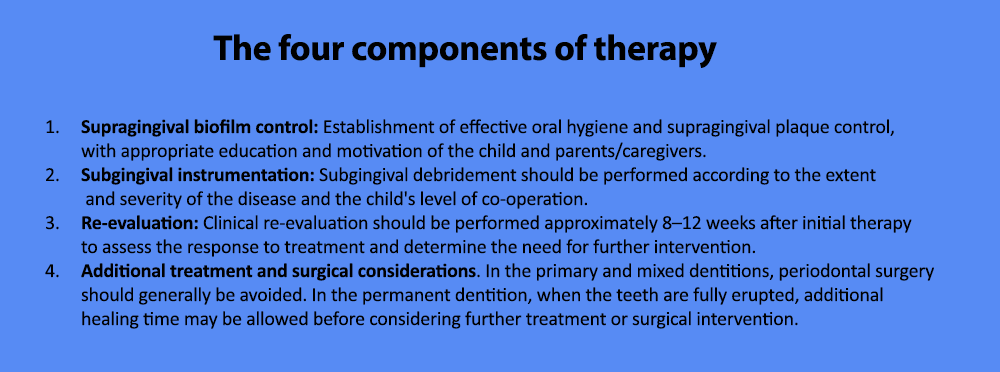
Periodontal therapy in the young population can be broadly structured into four components: supragingival biofilm control, subgingival instrumentation, re-evaluation, and additional treatment and surgical considerations.
The systematic use of systemic antimicrobials should be strictly limited to the most severe cases and should not be considered a routine component of periodontal therapy in children and adolescents. Insufficient evidence was identified to support the use of topical antimicrobials.
For NPDs, local debridement combined with antiseptic therapy is recommended. Systemic antimicrobials may be considered, particularly in chronically or severely systemically compromised patients and in cases presenting with systemic manifestations or severe disease.
In conclusion, periodontitis and other periodontal conditions should not be overlooked in paediatric patients, particularly when there are clinical signs of attachment loss, alveolar bone loss, or rapid periodontal destruction. However, diagnosis must be developmentally appropriate and clinicians should recognize the substantial uncertainty and limitations within the current evidence base.
Young children and adolescents with periodontal diseases can benefit substantially from close collaboration between paediatric dentists and periodontists. Such interdisciplinary co-operation is particularly important for establishing an accurate diagnosis, developing an age-appropriate treatment plan, and ensuring appropriate long-term periodontal management.
The EFP/EAPD focused workshop on gingival and periodontal diseases in children and adolescents was held in Madrid, Spain, in March 2025. The workshop was sponsored by Colgate-Palmolive, one of the EFP’s partners. The consensus report was published in the July 2026 edition of the Journal for Clinical Periodontology.
Bibliography
Chapple I, Gizani S, Sanz M, et al. 2026. “Gingival and Periodontal Diseases and Conditions in children and Adolescents: Consensus Report.” Journal of Clinical Periodontology 53(7):1068-1099. doi: 10.1111/jcpe.70033. Epub 2026 Apr 15.
Chapple I, Gizani S, Sanz M, et al. 2026. “Gingival and Periodontal Diseases and Conditions in children and Adolescents: Consensus Report.” European Archives of Paediatric Dentistry 28. https:// doi. org/10. 1007/ s4036 8-025-01154-y.
Eshkol-Yogev I, Ambrosio N, Somani C, Figuero E, Shapira L, Davies J. 2026. “Periodontitis and Periodontal Conditions in Systemically Healthy Children and Adolescents”. Journal of Clinical Periodontology 53(7):1100-1198.
Herrera D, Sanz M, Kebschull M, et al. 2022. “Treatment of stage IV periodontitis: The EFP S3 level clinical practice guideline”. Journal of Clinical Periodontology 49 (Suppl. 24):4-71.
Sanz M, Herrera D, Kebschull M, et al. 2020. “Treatment of stage I–III periodontitis: The EFP S3 level clinical practice guideline”. Journal of Clinical Periodontology 47:4-60.
Biography

Sotiria Gizani is professor, chair, and director of the postgraduate programme of the Paediatric Dentistry Department at the National and Kapodistrian University of Athens (Greece). She has served as secretary and is the current president of the European Academy of Paediatric Dentistry and has published more than 150 papers in peer-reviewed journals. Professor Gizani has received international awards and is a member of the editorial boards of European Archives of Paediatric Dentistry, Journal of Clinical Pediatric Dentistry, and Oralprophylaxe & Kinderzahnheilkunde (Springer). Her research interests focus mainly on prevention and management of caries/dental anomalies in young children and orthodontic patients, and oral healthcare of vulnerable children.
EFP partners









Sign up to our newsletter
The EFP publishes a free monthly email newsletter with the latest news about the federation's activities, its publications, and its campaigns.
